Public Administration Foundation Plus
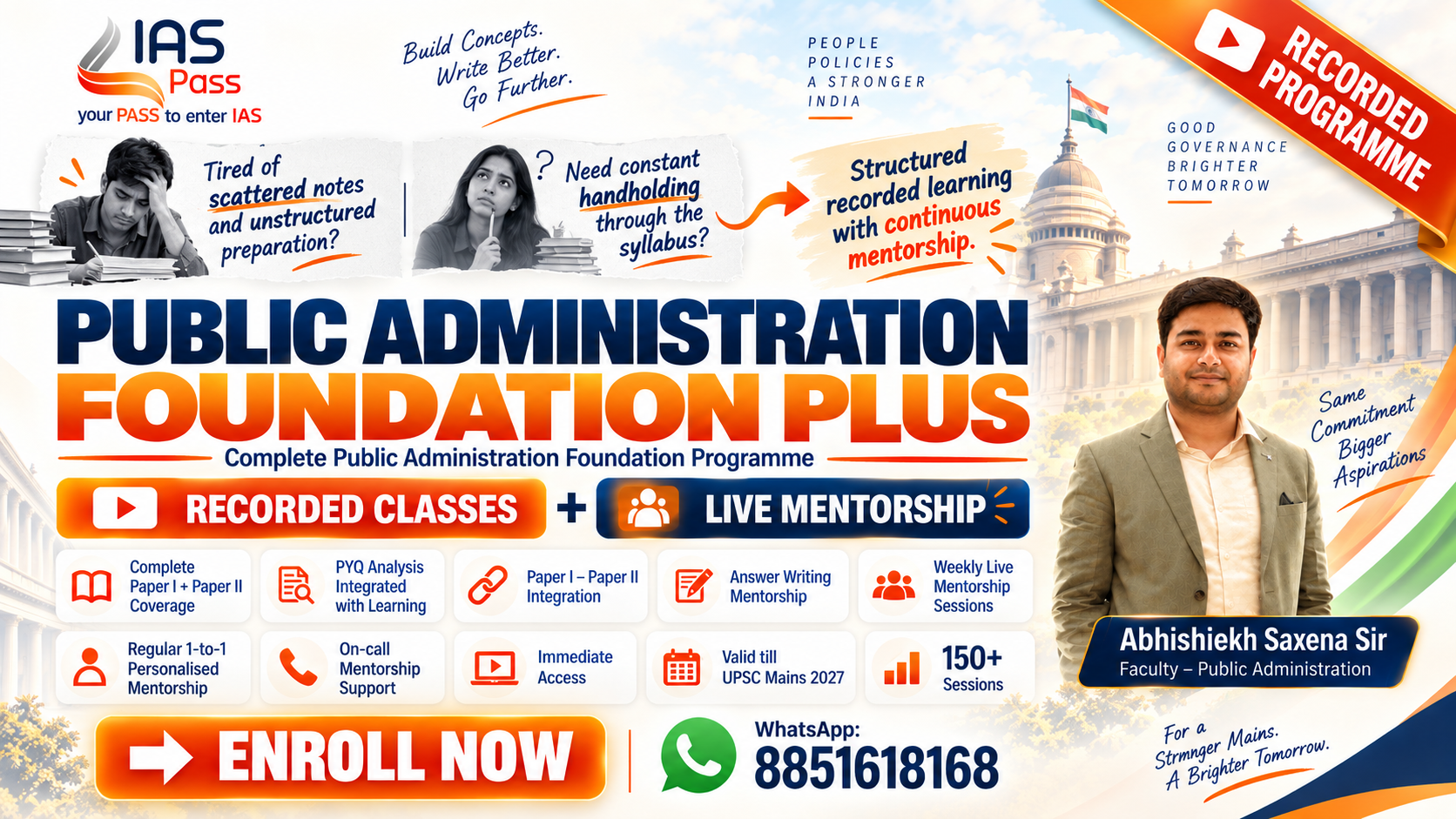
Public Administration Foundation Plus by IAS Pass is a complete Public Administration Optional Foundation Programme for UPSC CSE 2027, combining 150+ recorded sessions with live mentorship by Abhishiekh Saxena. Get immediate access to complete Paper I and Paper II coverage, integrated PYQ analysis, Paper I–Paper II int...
Choose Your Plan
Select the perfect pricing option that fits your needs
24/7 Support
Flexible Learning
Course Highlights
Complete Public Administration Foundation Programme | Recorded Classes + Live Mentorship
Public Administration preparation demands much more than simply completing the syllabus. It requires conceptual clarity, Paper I–Paper II integration, PYQ understanding, answer-writing orientation, systematic revision and continuous academic guidance.
At the same time, not every serious UPSC aspirant can organise preparation around a rigid live-class timetable.
You may be preparing General Studies simultaneously.
You may be a working professional or college student.
You may already have a demanding preparation schedule.
Or you may simply want the freedom to learn at your own pace without losing regular faculty guidance.
That is exactly what Public Administration Foundation Plus is designed to provide.
🎥 FOUNDATION = Complete Recorded Foundation Programme
🤝 PLUS = Live Mentorship & Continuous Handholding
Learn with flexibility. Stay guided throughout.
Public Administration Foundation Plus combines the flexibility of 150+ structured recorded sessions with the guidance, accountability and personal support of live mentorship by Abhishiekh Saxena.
You decide when you study.
But you are never left alone to figure out the preparation journey yourself.
Why Recorded Classes + Live Mentorship?
A conventional live classroom follows a fixed timetable.
But UPSC preparation does not always work according to a fixed timetable.
Missing a few live classes can create backlogs. Backlogs create pressure. Eventually, students either rush through the Optional or keep postponing it.
Foundation Plus solves this problem differently.
🎥 Recorded Classes Give You Flexibility
- Learn according to your own schedule
- Pause whenever required
- Revisit difficult concepts
- Revise important sessions multiple times
- Manage Public Administration alongside GS preparation
- Continue preparation alongside college or a job
- Avoid losing classes because of timetable clashes
🤝 Live Mentorship Gives You Direction
- Weekly live mentorship sessions
- Regular one-to-one personalised mentorship
- On-call mentorship support
- Conceptual doubt resolution
- Preparation strategy
- Revision planning
- Answer-writing mentorship
- Continuous academic handholding
Flexibility where you need it. Guidance where it matters.
🎥 150+ Recorded Sessions
Foundation Plus provides immediate access to 150+ structured recorded sessions covering the complete Public Administration Optional syllabus.
The recorded format allows you to build your preparation around your own timetable without compromising on conceptual depth or syllabus coverage.
This is not a collection of disconnected recordings.
The sessions have been organised as a complete Foundation learning pathway covering both papers systematically.
📚 Complete Paper I + Paper II Coverage
Paper I – Administrative Theory
Build conceptual clarity across the major areas of Administrative Theory, including:
- Introduction to Public Administration
- Administrative Thought
- Administrative Behaviour
- Organisations
- Accountability and Control
- Administrative Law
- Comparative Public Administration
- Development Dynamics
- Personnel Administration
- Public Policy
- Techniques of Administrative Improvement
- Financial Administration
Paper II – Indian Administration
Develop an integrated understanding of Indian Administration through areas including:
- Evolution of Indian Administration
- Constitutional and Philosophical Framework
- Union Government and Administration
- State Government and Administration
- District Administration
- Civil Services
- Public Sector Undertakings
- Plans and Priorities
- Financial Management
- Administrative Reforms
- Rural Development
- Urban Local Government
- Law and Order Administration
- Significant Issues in Indian Administration
The objective is not to prepare Paper I and Paper II as two isolated compartments.
Relevant theories, thinkers and administrative concepts from Paper I are continuously connected with institutions, governance issues and administrative realities in Paper II.
🔗 One Optional. Two Papers. One Integrated Preparation.
🔍 PYQ Analysis Integrated with Learning
Previous Year Questions should not be studied only after completing the syllabus.
In Foundation Plus, PYQ analysis is integrated with the learning process itself.
As you study a topic, you simultaneously learn:
- What UPSC has previously asked from that area
- Which themes repeatedly appear in the examination
- How UPSC converts a concept into a question
- Which dimensions of a topic deserve greater attention
- How different units of the syllabus are interconnected
- How Paper I and Paper II overlap
- What conceptual and analytical depth UPSC expects
The objective is to make your preparation PYQ-aware from the beginning.
Foundation Plus does not include a separate PYQ Test Series.
PYQs are used here as a tool for learning, understanding question demand and decoding the syllabus.
🗓️ Structured 4-Month Foundation Pathway
One of the biggest problems with recorded courses is not access.
It is completion.
Students often purchase recorded programmes, postpone classes and gradually build a large backlog.
Foundation Plus is designed to prevent that.
The programme provides a structured 4-month completion pathway so that a serious aspirant can systematically complete the Public Administration Foundation instead of watching classes randomly.
You receive the flexibility of recorded learning while live mentorship helps you stay connected to a preparation plan.
Study at your pace. But prepare with structure.
🤝 The “PLUS” in Foundation Plus = Live Mentorship
The recorded Foundation gives you flexibility.
The Plus gives you the human guidance required to use that flexibility effectively.
🤝 Weekly Live Mentorship Sessions
Regular live mentorship sessions with Abhishiekh Saxena will help students with:
- Conceptual doubts
- Preparation strategy
- PYQ understanding
- Paper I–Paper II integration
- Revision planning
- Syllabus prioritisation
- Answer-writing approach
- Preparation bottlenecks
- Source management
- Overall Optional strategy
The objective is to ensure that your preparation remains structured, accountable and continuously guided.
👤 Regular One-to-One Personalised Mentorship
Every aspirant faces a different preparation challenge.
One student may struggle with Administrative Thinkers.
Another may find Paper II overwhelming.
Someone may understand the concepts but struggle to convert them into effective answers.
Another aspirant may simply be unsure about what to study, how much to study and when to revise.
Foundation Plus therefore includes regular one-to-one personalised mentorship so that academic guidance can be aligned with your individual preparation stage, strengths, weaknesses and requirements.
Your preparation problem may be individual. Your guidance should be too.
📞 On-Call Mentorship Support
Preparation doubts do not always arise according to a classroom timetable.
At times, you may need clarity regarding your preparation strategy, revision plan, syllabus prioritisation or the direction in which your Optional preparation is moving.
Foundation Plus therefore includes on-call mentorship support for important academic and preparation-related concerns.
Flexibility should never mean academic isolation.
✍️ Answer-Writing Mentorship
Understanding Public Administration and writing a Public Administration answer are two different skills.
The mentorship component will help you progressively understand:
- How to interpret directive words
- How to structure Public Administration answers
- How to use thinkers and theories meaningfully
- How to connect Paper I concepts with Paper II realities
- How to use administrative examples effectively
- How to incorporate committees and reforms
- How to improve relevance and analytical depth
- How to approach PYQs from an answer-writing perspective
The objective is to gradually develop an exam-oriented way of thinking and writing Public Administration answers.
⚡ Immediate Access after Enrolment
There is no need to wait for the next conventional classroom batch.
Once enrolled, you can begin your Public Administration Foundation preparation immediately.
Start when you are ready.
Study according to your schedule.
Follow the structured completion pathway.
And continue receiving live mentorship throughout your preparation.
🎯 What You Get in Foundation Plus
- 🎥 150+ Recorded Sessions
- 📚 Complete Paper I + Paper II Coverage
- 🔍 PYQ Analysis Integrated with Learning
- 🔗 Paper I–Paper II Integration
- 🗓️ Structured 4-Month Completion Pathway
- ✍️ Answer-Writing Mentorship
- 🤝 Weekly Live Mentorship Sessions
- 👤 Regular One-to-One Personalised Mentorship
- 📞 On-Call Mentorship Support
- ⚡ Immediate Access
- 🎯 Validity till UPSC Mains 2027
👥 Who Is Foundation Plus Designed For?
Foundation Plus is particularly suitable for:
- UPSC CSE 2027 aspirants beginning Public Administration Optional from scratch
- Aspirants who cannot regularly attend fixed live classes
- Working professionals preparing for UPSC
- College students balancing academics with UPSC preparation
- Students simultaneously preparing General Studies and Optional
- Repeat aspirants looking to rebuild their Public Administration fundamentals
- Aspirants who want flexibility without losing faculty guidance
- Students looking for complete Paper I and Paper II preparation in one structured programme
Recorded Learning. Live Guidance. One Complete Foundation.
Public Administration Foundation Plus brings together two advantages that aspirants often have to choose between:
🎥 The flexibility of recorded learning
+
🤝 The accountability and guidance of live mentorship
With 150+ recorded sessions, complete Paper I and Paper II coverage, integrated PYQ analysis, answer-writing mentorship and continuous guidance by Abhishiekh Saxena, the programme provides a structured pathway for preparing Public Administration Optional for UPSC CSE 2027.
Complete Public Administration Foundation Programme | Recorded Classes + Live Mentorship
Learn at your pace. Stay guided throughout. Prepare with direction.
Course Features
What You Get with Public Administration Foundation Plus
Public Administration Foundation Plus is designed to give you the flexibility of recorded learning without leaving you academically isolated.
The programme combines a complete recorded Foundation with live mentorship, personalised guidance and continuous handholding so that your preparation remains structured, flexible and exam-oriented.
🎥 150+ Recorded Sessions
Get access to 150+ structured recorded sessions covering the complete Public Administration Foundation.
The recorded format allows you to:
- Study according to your own schedule
- Pause and revisit difficult concepts
- Revise important sessions multiple times
- Manage Optional preparation alongside GS, college or work
- Avoid backlogs caused by missing fixed live classes
Learn with flexibility without compromising on syllabus coverage.
📚 Complete Paper I + Paper II Coverage
The programme covers the complete Public Administration Optional syllabus across:
- Paper I – Administrative Theory
- Paper II – Indian Administration
Concepts, thinkers, administrative theories, institutions, reforms and governance issues are covered systematically to create a strong Foundation for UPSC CSE 2027.
🔍 PYQ Analysis Integrated with Learning
Previous Year Questions are integrated with relevant topics throughout the programme.
This helps you understand:
- What UPSC repeatedly asks
- Which themes are important
- How questions are framed from the syllabus
- What dimensions of a topic require greater attention
- How Paper I and Paper II themes overlap
- What conceptual depth UPSC expects
PYQs become part of the learning process rather than a last-stage activity.
🔗 Paper I–Paper II Integration
Public Administration cannot be prepared effectively by treating Paper I and Paper II as separate subjects.
Foundation Plus continuously connects administrative theories and thinkers from Paper I with Indian administrative institutions, governance issues and reforms in Paper II.
For example:
- Administrative theories with Indian bureaucracy
- Accountability with RTI, social audit and institutional mechanisms
- Public policy with welfare implementation
- Financial administration with budgeting, CAG and financial control
- Development administration with Indian development programmes
One Optional. Two Papers. One Integrated Preparation.
🗓️ Structured 4-Month Completion Pathway
Recorded courses often create flexibility but can also create procrastination and backlogs.
Foundation Plus addresses this through a structured 4-month completion pathway.
The recommended learning sequence helps you move systematically through the syllabus instead of watching recorded classes randomly.
Study at your own pace, but stay connected to a clear preparation plan.
✍️ Answer-Writing Mentorship
Mentorship includes guidance on how to convert your conceptual understanding into effective UPSC Mains answers.
The focus includes:
- Understanding directive words
- Structuring Public Administration answers
- Using thinkers and theories effectively
- Connecting Paper I concepts with Paper II realities
- Using administrative examples, committees and reforms
- Improving analytical depth and relevance
- Approaching PYQs from an answer-writing perspective
The objective is to progressively develop an exam-oriented answer-writing approach.
🤝 Weekly Live Mentorship Sessions
The flexibility of recorded classes is supported by weekly live mentorship sessions with Abhishiekh Saxena.
These sessions help with:
- Conceptual doubts
- Preparation strategy
- PYQ understanding
- Paper I–Paper II integration
- Revision planning
- Syllabus prioritisation
- Answer-writing approach
- Preparation bottlenecks
Recorded learning gives you flexibility. Live mentorship keeps you guided.
👤 Regular One-to-One Personalised Mentorship
Every aspirant has different strengths, weaknesses and preparation challenges.
Foundation Plus therefore includes regular one-to-one personalised mentorship so that guidance can be aligned with your individual preparation stage.
Mentorship can help you identify:
- Areas requiring greater conceptual clarity
- Units that need additional revision
- Weaknesses in answer-writing approach
- Issues in syllabus completion
- Problems in source management
- Gaps in preparation strategy
Your preparation is individual. Your mentorship should be too.
📞 On-Call Mentorship Support
Preparation doubts and strategic concerns do not always arise during scheduled classes.
Foundation Plus includes on-call mentorship support for important academic and preparation-related concerns.
This provides an additional layer of handholding when you need clarity regarding:
- Preparation direction
- Revision strategy
- Syllabus prioritisation
- Optional planning
- Academic doubts
Flexibility should never mean preparing in isolation.
⚡ Immediate Access
There is no need to wait for a conventional batch to begin.
Once enrolled, you receive immediate access to the recorded Foundation programme and can begin your preparation according to your own schedule.
Start when you are ready. Learn without waiting.
🎯 Valid till UPSC Mains 2027
The programme remains valid till UPSC Mains 2027, allowing you sufficient time to complete the Foundation, revisit recorded sessions, revise key areas and continue benefiting from the programme during your preparation cycle.
Foundation + Plus: The Complete Learning Model
Foundation Plus brings together two essential elements of effective Optional preparation:
🎥 FOUNDATION = Complete Recorded Learning
🤝 PLUS = Live Mentorship & Continuous Handholding
This combination gives you:
- Flexibility to study according to your own schedule
- Structure through a defined completion pathway
- Clarity through complete Paper I and Paper II coverage
- Exam orientation through integrated PYQ analysis
- Guidance through weekly live mentorship
- Personalisation through one-to-one mentorship
- Support through on-call mentorship
Recorded Learning. Live Guidance. Continuous Mentorship.
Learn at your pace. Stay guided throughout.
Frequently Asked Questions
Everything you need to know
Related Courses
You might also be interested in
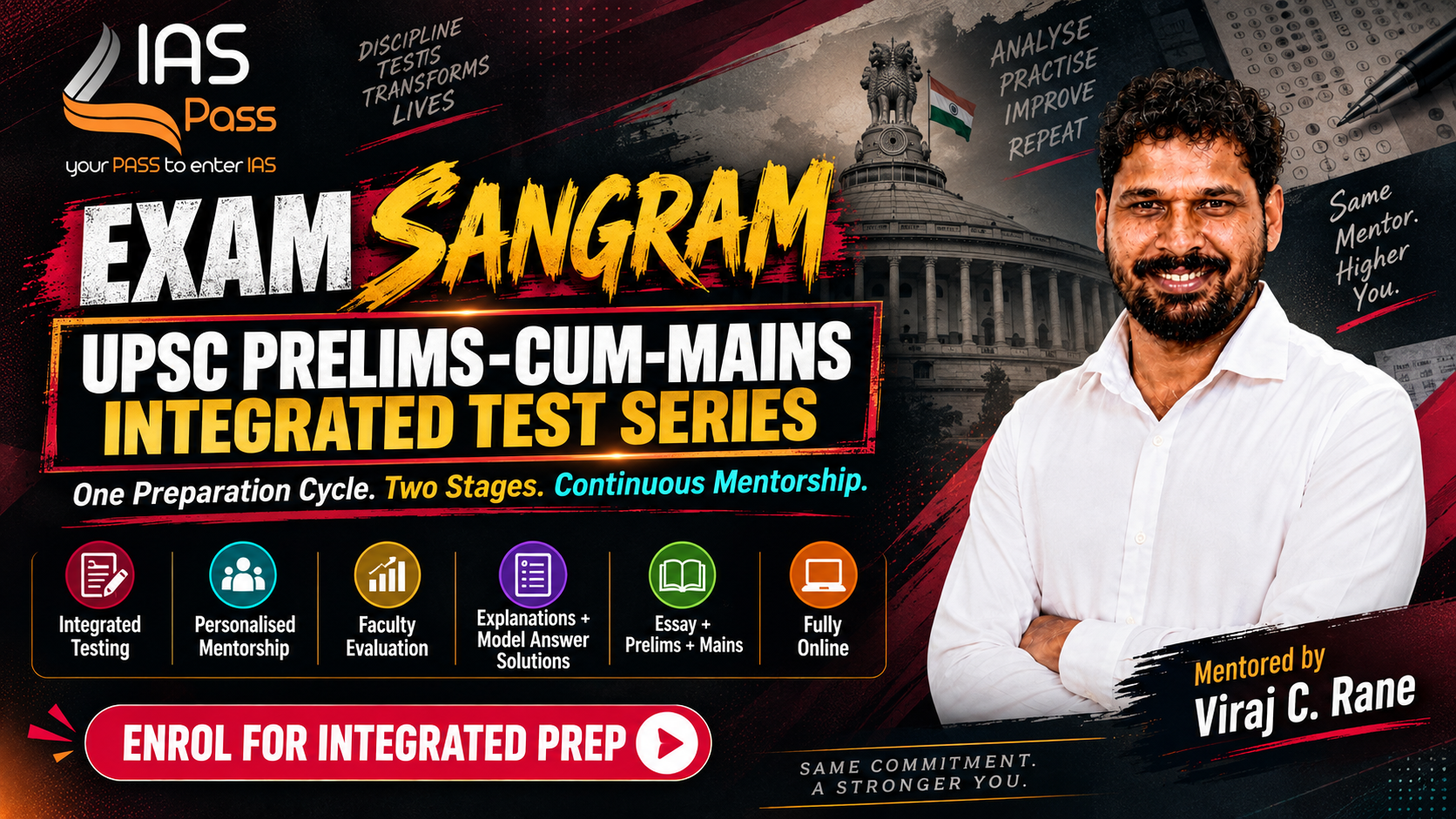
Exam Sangram 2027 – UPSC Prelims-cum-Mains Integrated Test Series
Exam Sangram 2027 is a UPSC Prelims-cum-Mains Integrated Test Series designed to...
View Details →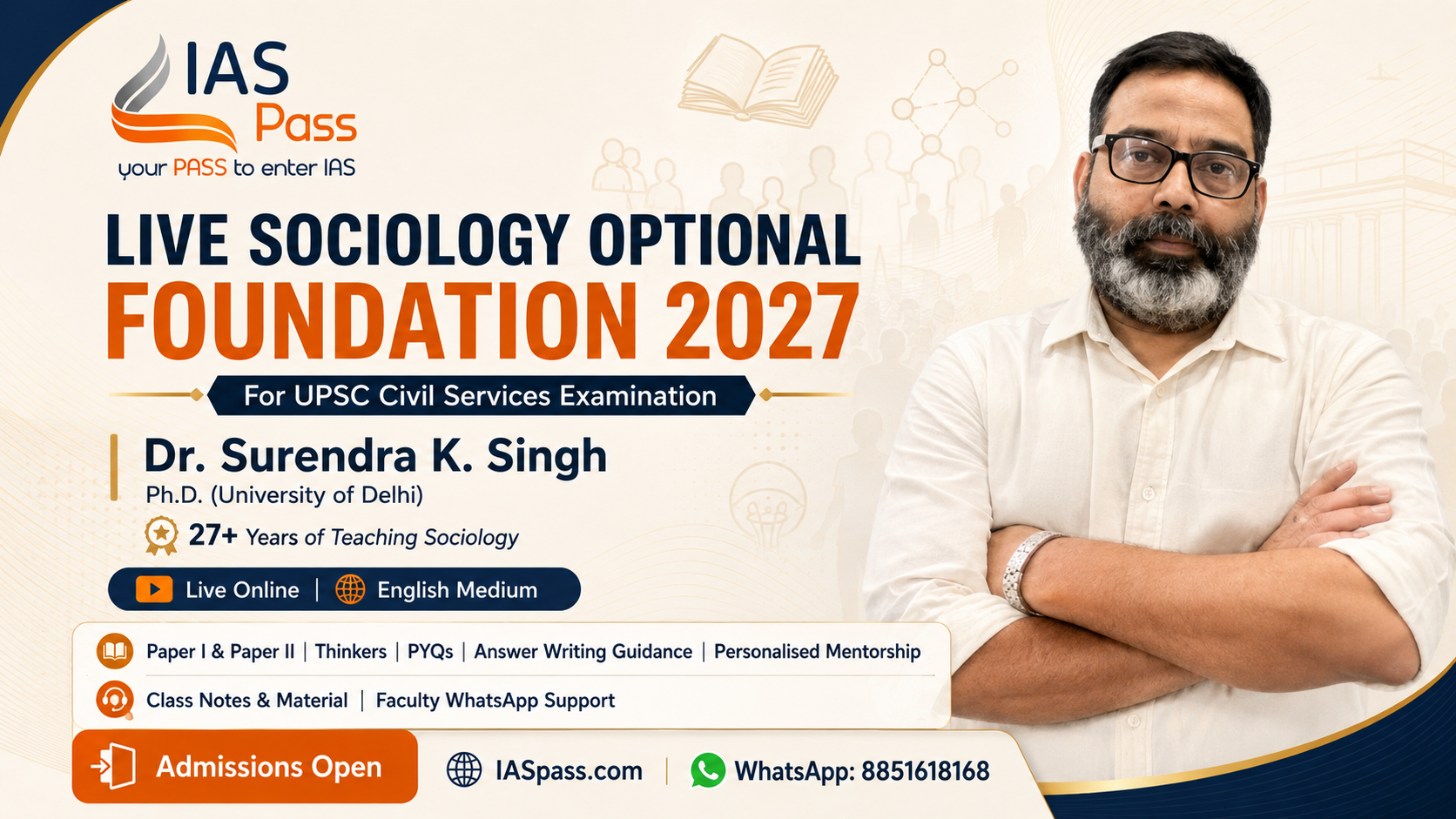
Sociology Optional Foundation 2027 | UPSC CSE | Dr. Surendra K. Singh
Sociology Optional Foundation Course for UPSC CSE 2027 with Dr. Surendra K. Sing...
View Details →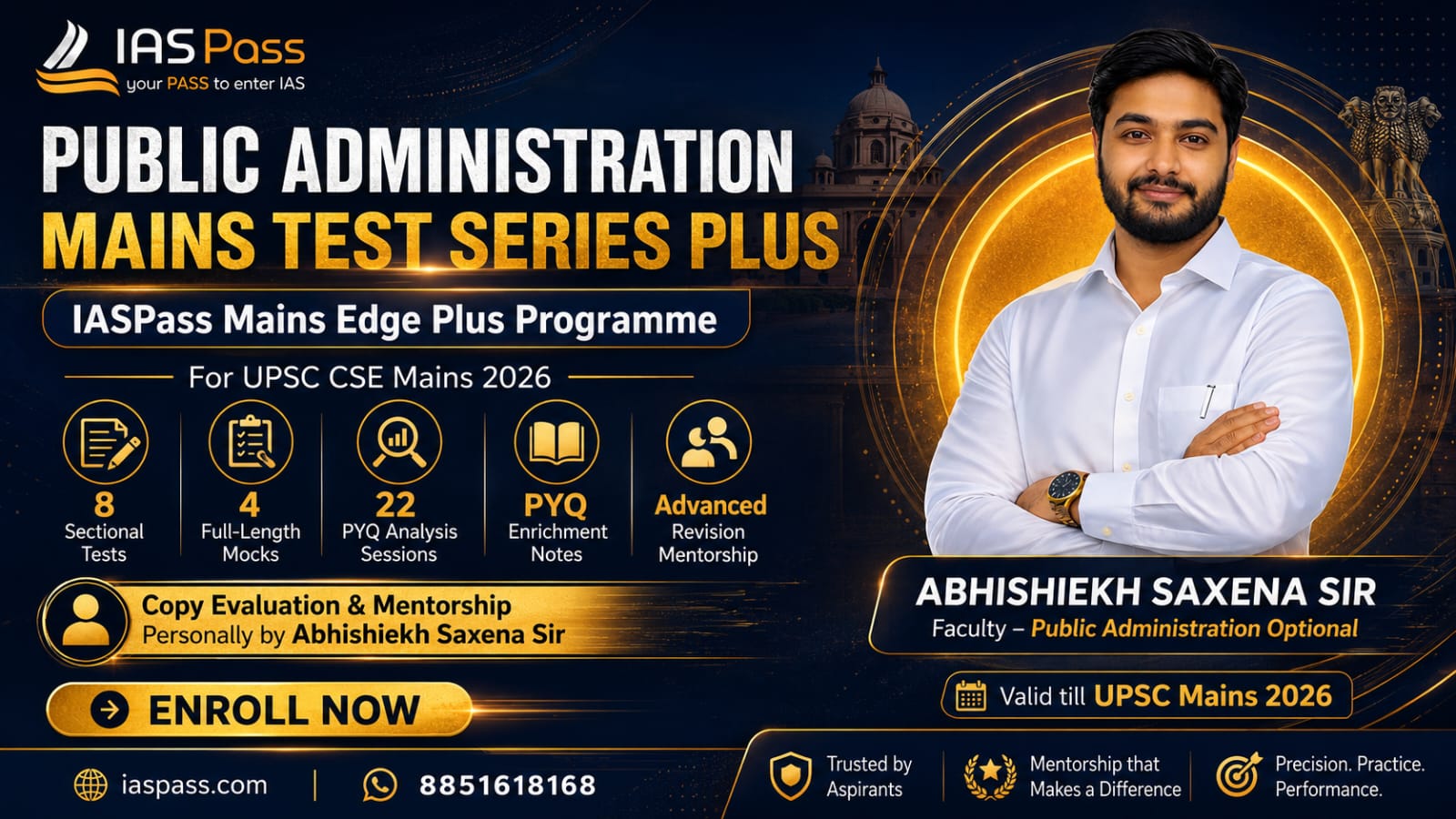
Public Administration Mains Test Series Plus
A complete Public Administration Optional Mains 2026 programme with 8 sectional...
View Details →