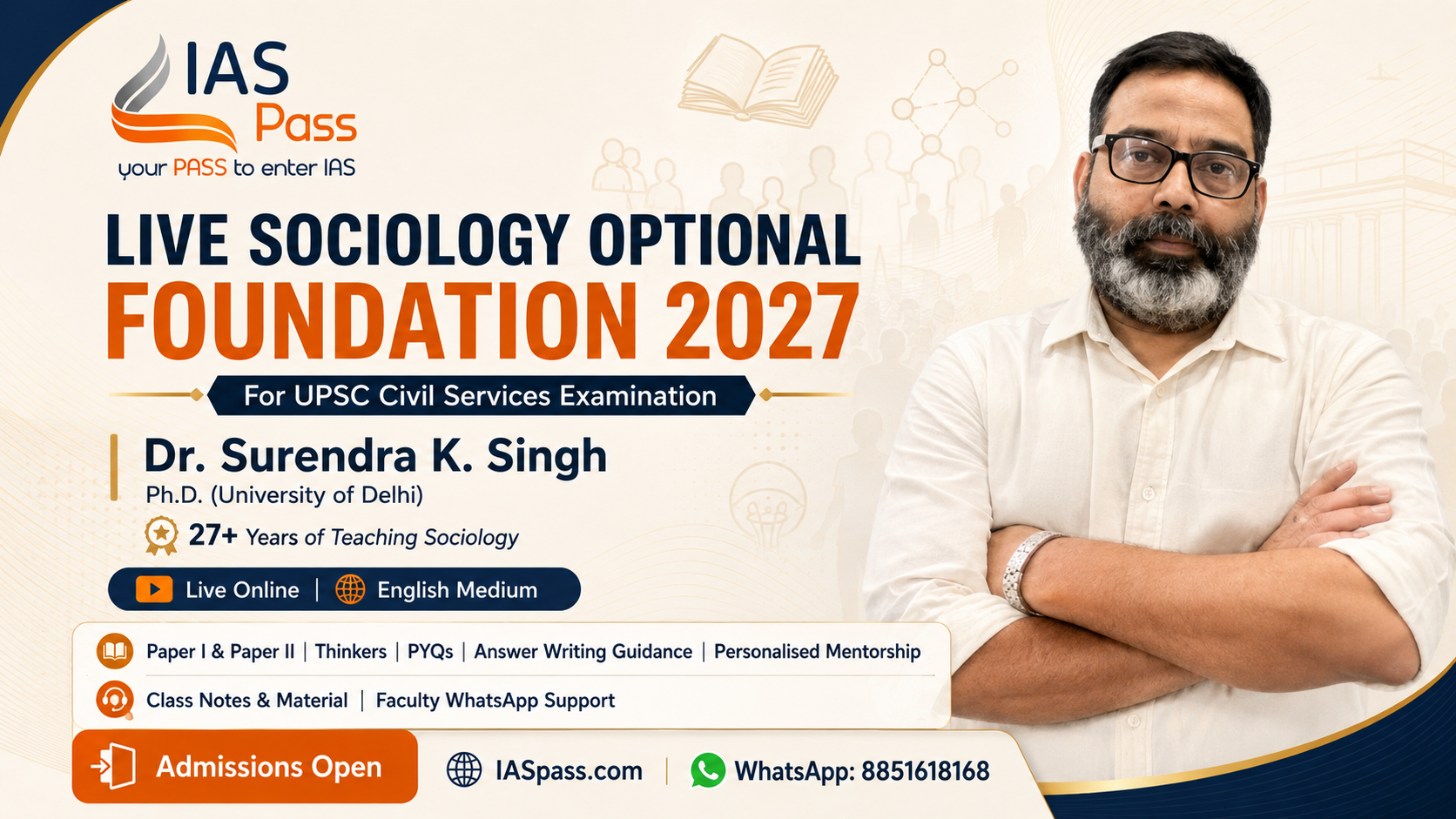
Sociology Optional Foundation 2027 | UPSC CSE | Dr. Surendra K. Singh
Sociology Optional Foundation Course for UPSC CSE 2027 with Dr. Surendra K. Singh. Complete Paper I & Paper II coverage with conceptual clarity, sociological thinkers, PYQ discussions, answer-writing guidance, faculty notes and personalised mentorship. Sociology Optional Foundation 2027 for UPSC CSE by Dr. Surendra K....
Choose Your Plan
Select the perfect pricing option that fits your needs
24/7 Support
Flexible Learning
Course Highlights
🎓 Sociology Optional Foundation 2027
Understand Sociology. Think Sociologically. Write for UPSC.
The IAS Pass Sociology Optional Foundation 2027 is a comprehensive Live Online programme for UPSC Civil Services Examination 2027, designed and taught by Dr. Surendra K. Singh — Ph.D., University of Delhi, with 27+ years of experience teaching Sociology to Civil Services aspirants.
The programme is designed not merely to complete the syllabus, but to help aspirants develop the conceptual clarity, sociological perspective and answer-writing orientation required to perform effectively in Sociology Optional.
📌 Programme at a Glance
🗓️ Classes: Monday to Friday
⏰ Timing: 11:00 AM – 1:30 PM
💻 Mode: Live Online + Class Recordings
⏳ Duration: Approx. 5 Months
🗣️ Medium: English
📚 Coverage: Complete Paper I & Paper II
📝 Faculty Notes & Study Material: Included
🔍 PYQ Discussions: Included
✍️ Answer-Writing Guidance: Included
🤝 Personalised Mentorship: Included
📱 Faculty WhatsApp Support: Included
🌟 Why This Sociology Foundation Programme?
Sociology Optional is not simply about learning definitions, thinkers and examples.
The real challenge is learning to think sociologically.
Many aspirants know the content but still struggle to:
🔸 Apply thinkers effectively in answers
🔸 Connect Paper I with Paper II
🔸 Convert contemporary issues into sociological analysis
🔸 Understand what a UPSC question is actually demanding
🔸 Differentiate a Sociology answer from a generic GS answer
🔸 Structure arguments using concepts, perspectives and examples
🔸 Receive timely guidance when preparation gets stuck
This Foundation programme is designed to address precisely these challenges.
🧠 The IAS Pass Sociology Learning Approach
UNDERSTAND → THINK → LINK → APPLY → WRITE
🔹 1. UNDERSTAND
Build strong foundations in:
- Sociological concepts
- Sociological theories
- Research methods
- Western thinkers
- Indian sociologists
- Social institutions
- Processes of social change
The course begins from the fundamentals, making it equally suitable for students with no prior academic background in Sociology.
---
🔹 2. THINK SOCIOLOGICALLY
Sociology is not merely the study of society. It is a particular way of understanding society.
Students will learn to examine social phenomena through concepts such as:
Structure • Agency • Power • Class • Status • Caste • Gender • Socialisation • Stratification • Religion • Kinship • Bureaucracy • Modernity • Social Change • Collective Action
The objective is to gradually develop the sociological imagination needed to analyse questions rather than merely reproduce notes.
---
🔹 3. LINK PAPER I WITH PAPER II
Paper I and Paper II will not be taught as two disconnected papers.
Students will learn to apply the theoretical tools of Paper I to Indian society in Paper II.
🔗 Illustrative Linkages
Stratification → Caste, Class & Gender in India
Marx & Weber → Class, Power, Status & Inequality
Religion → Religious Communities, Secularisation & Social Change
Kinship → Family, Marriage, Household & Patriarchy
Work & Economic Life → Agrarian Classes, Labour & Informal Sector
Social Change → Urbanisation, Education, Technology & Development
Politics & Society → Democracy, Citizenship, Elites & Social Movements
This integration helps students develop richer and distinctly sociological answers.
🔹 4. APPLY SOCIOLOGY
Concepts and theories become useful only when students know where and how to apply them.
Contemporary social developments will therefore be integrated wherever academically relevant, including:
👥 Caste & Social Mobility
👩 Gender & Changing Social Relations
🏠 Family & Household Transformation
🏙️ Urbanisation
🚶 Migration
💻 Technology & Digital Society
💼 Changing Nature of Work
⚖️ Inequality
🛕 Religion & Society
📢 Social Movements
🎓 Education
🌍 Development & Social Change
The objective is not to collect current affairs separately, but to interpret contemporary society sociologically.
🔹 5. WRITE FOR UPSC
Knowing Sociology and writing a good UPSC Sociology Optional answer are different skills.
The course will provide systematic guidance on:
✍️ Understanding the demand of the question
✍️ Developing effective introductions
✍️ Using sociological terminology
✍️ Selecting relevant thinkers
✍️ Integrating theory with examples
✍️ Building arguments and counter-perspectives
✍️ Linking Paper I concepts with Paper II
✍️ Structuring the body logically
✍️ Developing analytical conclusions
The aim is to help students move from:
“I know the topic” → “I can answer the question sociologically.”
📚 Complete Sociology Optional Syllabus Coverage
📘 PAPER I – Fundamentals of Sociology
The programme will comprehensively cover:
1️⃣ Sociology – The Discipline
- Emergence of Sociology
- Modernity and social change
- Scope of Sociology
- Sociology and other social sciences
- Sociology and common sense
2️⃣ Sociology as Science
- Science and scientific method
- Positivism and its critique
- Fact, value and objectivity
- Non-positivist methodologies
3️⃣ Research Methods & Analysis
- Quantitative and qualitative methods
- Techniques of data collection
- Variables
- Sampling
- Hypothesis
- Reliability and validity
4️⃣ Sociological Thinkers
Detailed conceptual study and application of:
- Karl Marx
- Emile Durkheim
- Max Weber
- Talcott Parsons
- Robert K. Merton
- George Herbert Mead
5️⃣ Stratification & Mobility
6️⃣ Work & Economic Life
7️⃣ Politics & Society
8️⃣ Religion & Society
9️⃣ Systems of Kinship
🔟 Social Change in Modern Society
---
📕 PAPER II – Indian Society: Structure and Change
Paper II will be taught through a sociological lens, using the concepts developed in Paper I.
🇮🇳 Introducing Indian Society
- Perspectives on Indian Society
- G.S. Ghurye
- M.N. Srinivas
- A.R. Desai
- Impact of colonial rule
- Nationalism, modernisation and social reforms
🌾 Rural & Agrarian Social Structure
- Indian village
- Village studies
- Land tenure
- Land reforms
- Agrarian relations
🧩 Caste System
- Major sociological perspectives
- Features and transformation of caste
- Untouchability
- Caste, class and mobility
🌿 Tribal Communities in India
- Definitional issues
- Distribution
- Colonial policies
- Integration and autonomy
👥 Social Classes in India
- Agrarian classes
- Industrial classes
- Middle class
👨👩👧 Systems of Kinship
- Lineage and descent
- Marriage
- Family
- Household
- Patriarchy
- Gendered division of labour
🛕 Religion & Society
- Religious communities
- Minorities
- Secularisation
- Changing relationship between religion and society
🔄 Social Change in India
- Development planning
- Rural transformation
- Green Revolution
- Industrialisation
- Urbanisation
- Politics and society
- Social movements
- Population dynamics
- Development and displacement
- Poverty and inequality
- Gender violence
- Caste and ethnic conflicts
- Communalism and religious revivalism
---
👨🏫 Master Thinkers — Don't Just Memorise Them
One of the biggest challenges in Sociology Optional is not learning what a thinker said, but understanding how and where to use the thinker.
The programme will focus on:
✅ Core arguments of each thinker
✅ Key sociological concepts
✅ Comparison between thinkers
✅ Criticisms and limitations
✅ Contemporary relevance
✅ Application to Indian society
✅ Paper I–Paper II linkages
✅ Effective use of thinkers in UPSC answers
The objective is to make thinkers tools of analysis rather than material for rote learning.
🔍 PYQ-Oriented Preparation
UPSC Previous Year Questions are an essential part of understanding the examination.
Relevant Sociology Optional PYQs will be integrated with classroom teaching to identify:
📌 Recurring themes
📌 Changing patterns of questioning
📌 Conceptual depth expected by UPSC
📌 Application-based questions
📌 Paper I–Paper II interlinkages
📌 Different ways in which the same topic can be asked
📌 The actual demand hidden within a question
The objective is not to memorise model answers, but to learn how to independently interpret and approach UPSC Sociology questions.
---
✍️ Answer-Writing Guidance
Answer writing will form an integral part of the learning process.
Students will receive guidance on:
📝 Question interpretation
📝 Answer structure
📝 Sociological vocabulary
📝 Thinker application
📝 Theory–example integration
📝 Paper I–Paper II linkage
📝 Analytical arguments
📝 Effective introductions and conclusions
⚠️ Important Clarification
A formal Sociology Optional Test Series is NOT included in this Foundation programme.
The course includes PYQ discussions, answer-writing guidance and faculty mentorship, but there is no bundled sectional or full-length evaluated Test Series.
🤝 Personalised Mentorship with Dr. Surendra K. Singh
A key strength of the programme is faculty accessibility.
Dr. Surendra K. Singh holds a Ph.D. from the University of Delhi and has been teaching Sociology to Civil Services aspirants since 1999.
Across more than 27 years of teaching, he has taught and mentored aspirants through leading Civil Services institutions, including Rau's IAS and GS SCORE, along with other academic engagements.
At IAS Pass, the emphasis goes beyond simply delivering classroom lectures.
Students will receive personalised academic guidance relating to:
💡 Conceptual difficulties
📚 Sociological thinkers
🔗 Paper I–Paper II integration
🔍 PYQs
✍️ Answer-writing approach
🗂️ Preparation strategy
❓ Academic doubts
🎯 Individual preparation challenges
📱 Faculty WhatsApp Support
Enrolled students will also receive WhatsApp-based academic support from the faculty.
This provides students with an additional channel for:
✅ Conceptual doubts
✅ Preparation-related queries
✅ Academic guidance
✅ Clarification of difficult topics
The idea is to make mentorship more accessible and continuous.
---
🎥 Live Classes + Recordings
💻 Live Online Classes
📅 Monday to Friday
⏰ 11:00 AM – 1:30 PM
⏳ Approx. Course Duration: 5 Months
🗣️ Medium: English
Students will also receive class recordings, allowing them to revisit difficult topics and maintain continuity in preparation.
---
📒 Faculty Notes & Study Material
Students will receive class notes and relevant academic material provided by Dr. Surendra K. Singh.
The emphasis will be on providing material that helps students:
📖 Understand concepts
🧠 Consolidate classroom learning
🔄 Revise systematically
✍️ Prepare for answer writing
The objective is to provide useful and manageable academic material, rather than burden aspirants with excessive sources.
---
🎯 Who Should Join?
This programme is ideal for:
🎓 UPSC CSE 2027 aspirants choosing Sociology Optional
🌱 Beginners starting Sociology from scratch
🔬 Students from Engineering, Science, Commerce or other non-Sociology backgrounds
📚 Aspirants who have studied Sociology earlier but lack conceptual clarity
🧠 Students struggling with sociological thinkers
📝 Aspirants whose Paper II answers resemble General Studies answers
🔄 Repeat aspirants seeking better integration and conceptual depth
🤝 Students looking for direct faculty guidance and mentorship
No prior academic background in Sociology is required.
🏆 What Should You Gain from the Programme?
By the end of the Foundation programme, students should be better equipped to:
✅ Understand the complete Sociology Optional syllabus
✅ Develop command over major concepts and thinkers
✅ Think through social issues sociologically
✅ Integrate Paper I with Paper II
✅ Interpret UPSC PYQs more intelligently
✅ Apply thinkers instead of merely quoting them
✅ Use contemporary examples effectively
✅ Distinguish Sociology answers from generic GS answers
✅ Structure analytical answers better
✅ Revise Sociology systematically
✅ Approach the Optional with greater academic confidence
🆓 Join the Free Sociology Optional Community
Preparing Sociology Optional or still exploring the subject?
Join the FREE IAS Pass Sociology Telegram Community for discussions, learning activities, updates and free academic guidance.
👉 https://t.me/IASPassSocio
The Telegram Community & guidance shared there are FREE.
---
📞 Admissions & Queries
📲 WhatsApp: 8851618168
🌐 Website: IASpass.com
Sociology Optional Foundation 2027 | IAS Pass
Understand Sociology. Think Sociologically. Write for UPSC.
Course Features
🌟 Course Features
👨🏫 Learn with Dr. Surendra K. Singh
Ph.D., University of Delhi | 27+ Years of Teaching Sociology to Civil Services aspirants.
📚 Complete Paper I & Paper II Coverage
Systematic coverage of the entire UPSC Sociology Optional syllabus, from foundational concepts to Indian Society and social change.
🧠 Conceptual Clarity First
Build a strong understanding of sociological concepts, theories and debates instead of relying on rote learning.
👥 Master Sociological Thinkers
Understand Marx, Durkheim, Weber, Parsons, Merton, Mead and major Indian sociologists with emphasis on their application in UPSC answers.
🔗 Paper I–Paper II Integration
Learn how theoretical concepts from Paper I can be intelligently applied to caste, class, family, religion, politics, social movements, inequality and other themes of Indian Society.
🔍 PYQ-Oriented Preparation
Relevant UPSC Sociology Optional Previous Year Questions will be integrated with classroom discussions to understand recurring themes, question demand and UPSC's evolving approach.
✍️ Answer-Writing Guidance
Develop the ability to interpret questions, structure answers, use sociological vocabulary, apply thinkers and integrate theory with examples.
🤝 Personalised Mentorship
Receive academic guidance directly from Dr. Surendra K. Singh for conceptual difficulties, preparation strategy, PYQs and answer-writing improvement.
📱 Faculty WhatsApp Support
Enrolled students receive WhatsApp-based academic support for doubts, conceptual queries and preparation-related guidance.
🎥 Live Online Classes
Interactive classes conducted Monday to Friday | 11:00 AM–1:30 PM.
▶️ Class Recordings Provided
Recordings will be made available after classes so students can revise difficult topics and maintain continuity in preparation.
📒 Faculty Notes & Study Material
Receive structured class notes and relevant academic material provided by the faculty to support learning and revision.
🌍 Contemporary Sociological Linkages
Learn to connect sociological concepts with contemporary themes such as caste, gender, migration, urbanisation, digital society, inequality, changing family structures and social movements.
🎯 Develop a Sociological Perspective
Move beyond merely knowing content and learn to think sociologically, analyse social phenomena and write distinctly sociological answers.
🌱 Beginner Friendly
Suitable even for aspirants from Engineering, Science, Commerce or other non-Sociology backgrounds. No previous academic study of Sociology is required.
🗣️ English Medium
Classes and core academic instruction will be conducted in English.
⏳ Structured 5-Month Foundation
Approximately 5 months of systematic preparation designed to build the Optional progressively from fundamentals to application.
🧭 Focused Foundation Programme
The programme concentrates on teaching, conceptual development, PYQs, answer-writing guidance and mentorship.
A formal Sociology Optional Test Series is not included in this programme.
🆓 Free Sociology Learning Community
Students can also join the FREE IAS Pass Sociology Telegram Community for discussions, learning activities and academic guidance:
👉 https://t.me/IASPassSocio
Frequently Asked Questions
Everything you need to know
Related Courses
You might also be interested in
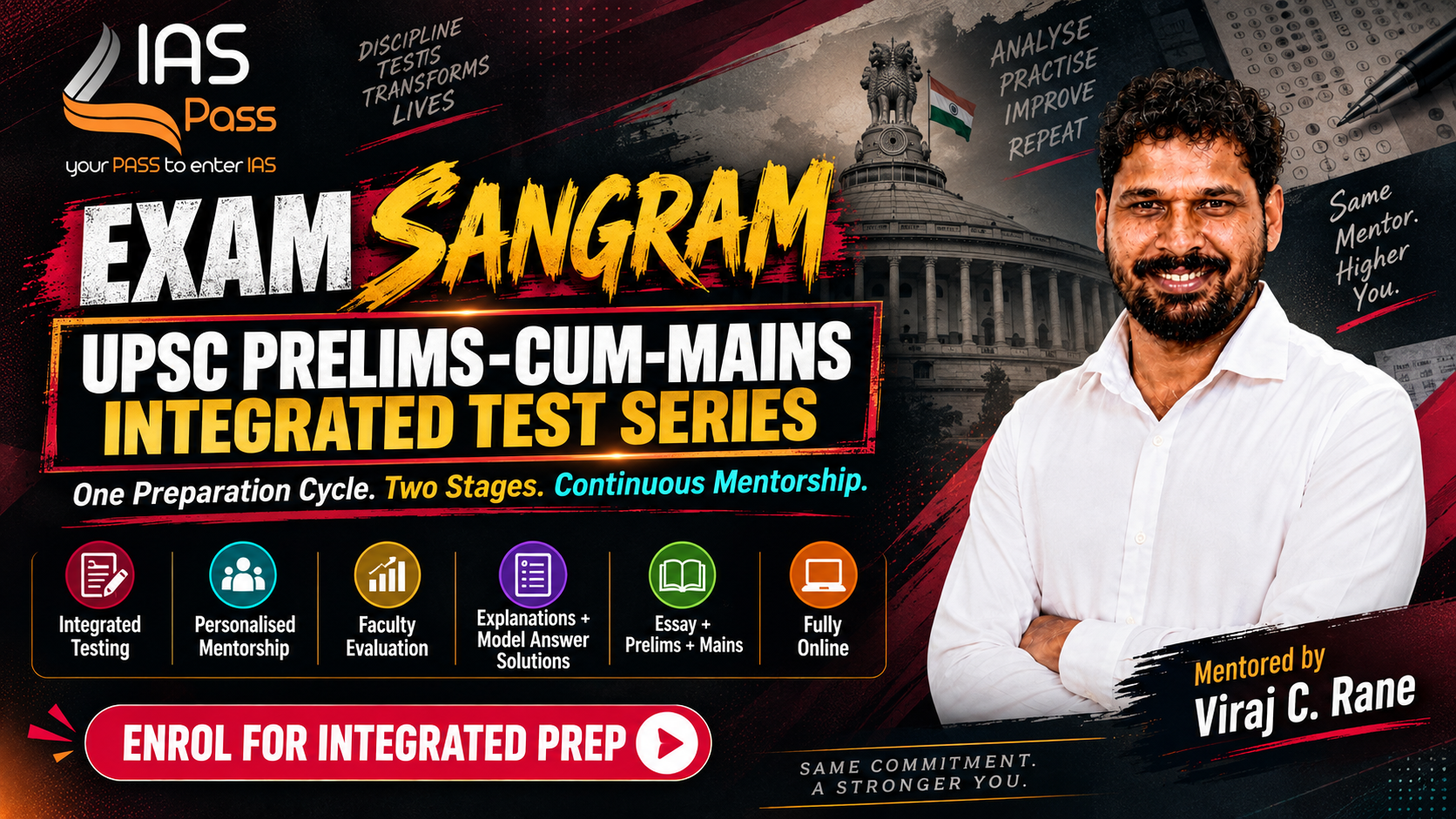
Exam Sangram 2027 – UPSC Prelims-cum-Mains Integrated Test Series
Exam Sangram 2027 is a UPSC Prelims-cum-Mains Integrated Test Series designed to...
View Details →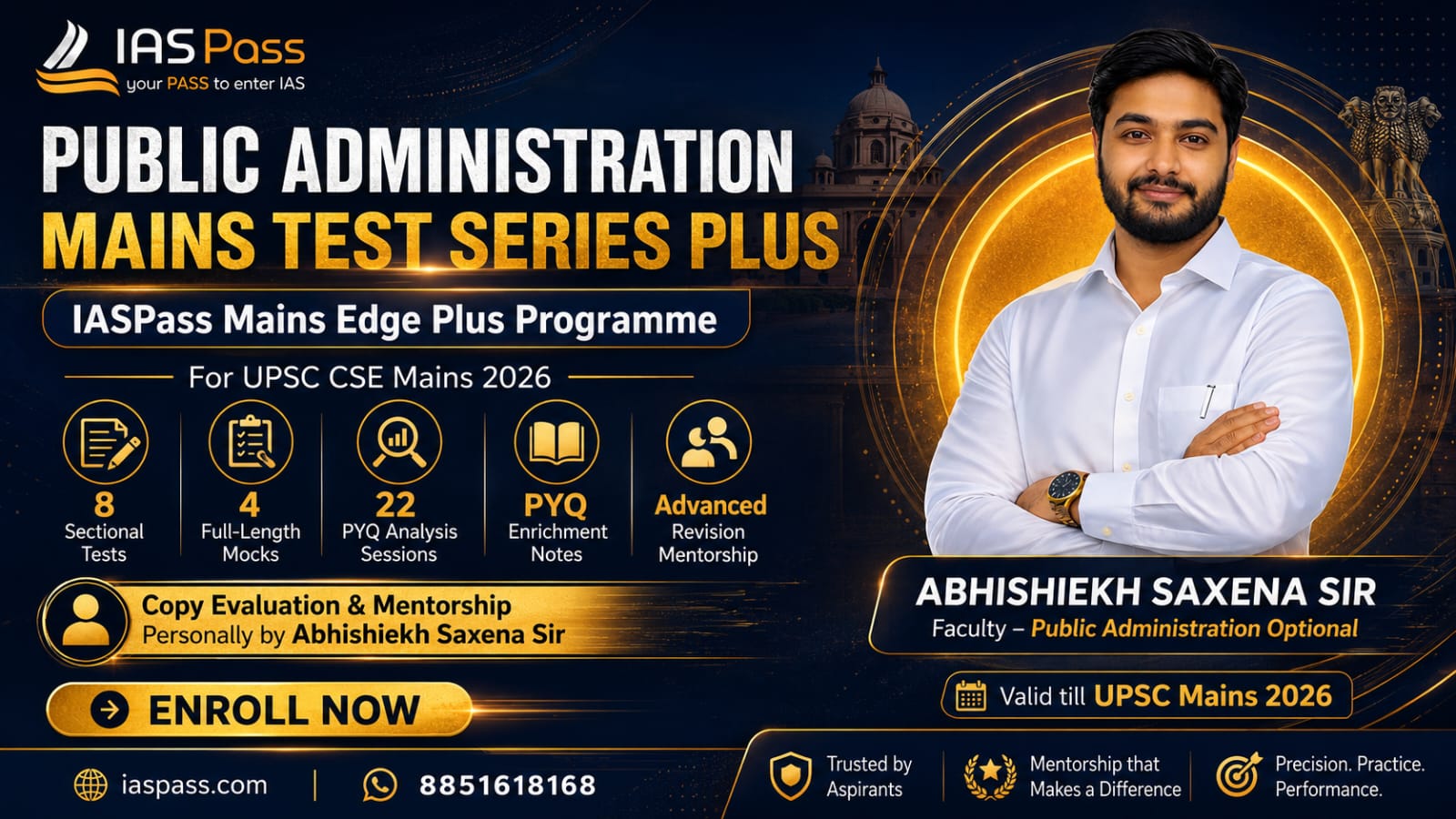
Public Administration Mains Test Series Plus
A complete Public Administration Optional Mains 2026 programme with 8 sectional...
View Details →
Answer Writing Edge
Learn the art of UPSC Mains answer writing through 5 conceptual sessions, 21 day...
View Details →