
UPSC Current Affairs Course for CSE 2027
Prepare current affairs for UPSC Prelims and Mains with Viraj C. Rane Sir through twice-a-week lectures, PYQ linkage, session-wise notes, MCQ practice, Mains questions, monthly tests, evaluation and mentorship.
Choose Your Plan
Select the perfect pricing option that fits your needs
24/7 Support
Flexible Learning
Course Highlights
Why Current Affairs Needs a Different Approach
Most UPSC aspirants read newspapers, monthly magazines, websites, PDFs and online content regularly. Yet, many of them remain confused about three basic questions:
What should I read?
What should I ignore?
How will UPSC ask this in Prelims or Mains?
The real challenge in current affairs preparation is not lack of material.
The real challenge is lack of direction, linkage, revision and application.
Aspirants often know the news, but they struggle to convert it into:
- Prelims accuracy
- Mains examples
- Data points
- Analytical arguments
- PYQ understanding
- MCQ solving ability
- Answer-writing value addition
IASPass Current Affairs Edgesolves this problem by teaching current affairs through a structured UPSC framework.
What Makes IASPass Current Affairs Edge Different?
This is not a generic news-explanation course.
It is a UPSC application-based current affairs programmewhere every important issue is taught through the lens of:
· Prelims relevance
· Mains relevance
· Static syllabus linkage
· GS paper interlinking
· PYQ-based understanding
· MCQ practice
· Mains answer-writing application
· Monthly tests
· Evaluation and mentorship
The goal is simple:
Learn → Link → Decode PYQs → Practise → Revise → Improve
1. Current Affairs Lectures Twice a Week
Classes will be conducted every:
Wednesday and Saturday
Each lecture will help students understand:
- What is important for UPSC Prelims
- What is important for UPSC Mains
- How the issue connects with static subjects
- How it links with different GS papers
- How UPSC may frame MCQs from the topic
- How the topic can be used in Mains answers
- What facts, concepts, data and analysis should be remembered
2. Prelims and Mains Focus in Every Lecture
Every topic will be covered from both examination angles.
For Prelims
Students will learn:
- Important facts and concepts
- Schemes, institutions and reports
- Constitutional and legal provisions
- Places, species and technologies in news
- International organisations
- Reports, indices and data
- UPSC-style statement traps
- Elimination-based MCQ approach
For Mains
Students will learn:
- How to use current affairs in answers
- How to add examples and case studies
- How to use data, reports and committees
- How to connect current issues with GS syllabus themes
- How to build balanced arguments
- How to write better introductions, conclusions and way forward
- How to make answers more contemporary and analytical
3. PYQ Linkage in Relevant Lectures
UPSC does not ask current affairs randomly. It usually connects current developments with static concepts, institutional understanding, policy debates and analytical themes.
That is why relevant PYQs will be discussed wherever a current affairs topic connects with previous UPSC questions.
This will help students understand:
- How UPSC has previously asked similar themes
- How current affairs are converted into Prelims MCQs
- How contemporary issues are used in Mains questions
- What facts and concepts UPSC usually tests
- What kind of analysis UPSC expects
- How to predict possible question framing from current topics
4. Static Syllabus Interlinking
Current affairs becomes useful only when it is connected with the syllabus.
In this programme, every important issue will be linked with relevant areas of:
- Polity and Constitution
- Governance
- Economy
- Environment and Ecology
- Geography
- International Relations
- Science and Technology
- Social Justice
- Internal Security
- Ethics
- Essay
This will help students understand that current affairs is not separate from the UPSC syllabus.
It is an extension of the syllabus.
5. Session-wise Current Affairs Notes
Current affairs notes will be provided for every session.
These notes will help students revise:
- Key facts
- Prelims pointers
- Mains value additions
- Static linkages
- PYQ connections
- Probable question areas
- Important examples and data points
The purpose is to make revision structured, concise and exam-oriented.
6. Practice with Every Session
Every lecture will be accompanied by:
5 Prelims MCQs
1 Mains Question
This ensures that students do not merely listen to current affairs.
They learn how to apply it in the actual exam.
The MCQs will improve statement analysis, factual clarity and elimination skills.
The Mains question will train students to use current affairs in analytical answers.
7. Monthly Current Affairs Test Series
Every month, students will get:
1 Prelims Current Affairs Test
50 MCQs
1 Mains Current Affairs Test
5 Mains Questions
These tests will help students revise the month’s current affairs in an exam-oriented manner.
The monthly tests will improve:
- Retention
- MCQ solving ability
- Mains answer-writing ability
- Current affairs application
- Time management
- Conceptual clarity
- Performance tracking
8. Answer Evaluation and Mentorship by Viraj C. Rane Sir
Mains answers will be supported by evaluation and mentorship by Viraj C. Rane Sir.
The focus will be on improving:
- Relevance of content
- Use of current affairs
- Answer structure
- Analytical depth
- Introduction and conclusion
- Examples and data usage
- Value addition
- UPSC-oriented presentation
This makes the programme more than a current affairs class.
It becomes a guided preparation system.
Course Features
Weekly Academic Cycle
Wednesday: Current Affairs Lecture
- Prelims relevance
- Mains relevance
- Static syllabus linkage
- PYQ reference on similar topics
- 5 MCQs
- 1 Mains question
Saturday: Current Affairs Lecture
- Issue-based analysis
- GS interlinking
- PYQ-based understanding
- MCQ practice
- Mains answer-writing practice
Monday: Doubt Solving and Mentorship
Doubt clarification
Strategy guidance
Question discussion
Preparation correction
Mentorship by Viraj C. Rane Sir
Coverage Areas
IASPass Current Affairs Edge will cover important current affairs from:
- Polity and Constitution
- Governance
- Economy
- Environment and Ecology
- Geography and Places in News
- International Relations
- Science and Technology
- Internal Security
- Social Justice
- Ethics and Essay-related themes
- Government Schemes
- Reports, Indices and Data
- Important Judgments
- Institutions and Organisations
- Prelims-focused factual developments
- Mains-focused analytical issues
What You Will Get
- Current affairs lectures twice a week
- Classes every Wednesday and Saturday
- Monday doubt-solving and mentorship sessions
- Faculty guidance by Viraj C. Rane Sir
- Session-wise current affairs notes
- Clear Prelims and Mains focus in every lecture
- Static syllabus linkage
- Interlinking across GS subjects
- PYQ references on similar topics
- Understanding of UPSC question framing
- 5 MCQs with every lecture
- 1 Mains question with every lecture
- Monthly 50-question Prelims current affairs test
- Monthly 5-question Mains current affairs test
- Answer evaluation and mentorship support
- Validity till UPSC Prelims 2027
Who Should Join IASPass Current Affairs Edge?
This programme is ideal for:
- UPSC CSE 2027 aspirants
- Beginners confused about current affairs
- Repeaters who struggle with application
- Working professionals who need structured coverage
- Students weak in MCQ solving
- Students unable to use current affairs in Mains answers
- Aspirants who want current affairs linked with the static syllabus
- Aspirants who want to understand UPSC’s PYQ-based question framing
- Aspirants who want regular revision through tests and mentorship
Why This Course Matters for UPSC CSE 2027
For UPSC CSE 2027, current affairs preparation cannot be left for the final months.
Students need a regular system that helps them:
- Follow important developments
- Understand their syllabus relevance
- Practise MCQs
- Write Mains answers
- Revise regularly
- Track progress through tests
- Correct mistakes through mentorship
IASPass Current Affairs Edge gives students this complete cycle.
It helps aspirants move from passive readingto active exam preparation.
Course Details
|
Detail |
Information |
|
Course Name |
IASPass Current Affairs Edge |
|
Target Exam |
UPSC CSE 2027 |
|
Faculty |
Viraj C. Rane Sir |
|
Class Days |
Wednesday and Saturday |
|
Mentorship Day |
Monday |
|
Session Practice |
5 MCQs + 1 Mains Question |
|
Monthly Prelims Test |
50 MCQs |
|
Monthly Mains Test |
5 Questions |
|
Notes |
Session-wise Current Affairs Notes |
|
Validity |
Till UPSC Prelims 2027 |
|
Mode |
Online |
Programme Philosophy
Current affairs should not be random reading.
It should be a guided process of:
Learning → Linking → Decoding PYQs → Practising → Revising → Improving
IASPass Current Affairs Edge is built on this philosophy.
The course helps students understand not just what happened, but also:
- Why it matters for UPSC
- Where it fits in the syllabus
- How it can be asked in Prelims
- How it can enrich Mains answers
- How it connects with PYQs
How it should be revised
Frequently Asked Questions
Everything you need to know
Related Courses
You might also be interested in
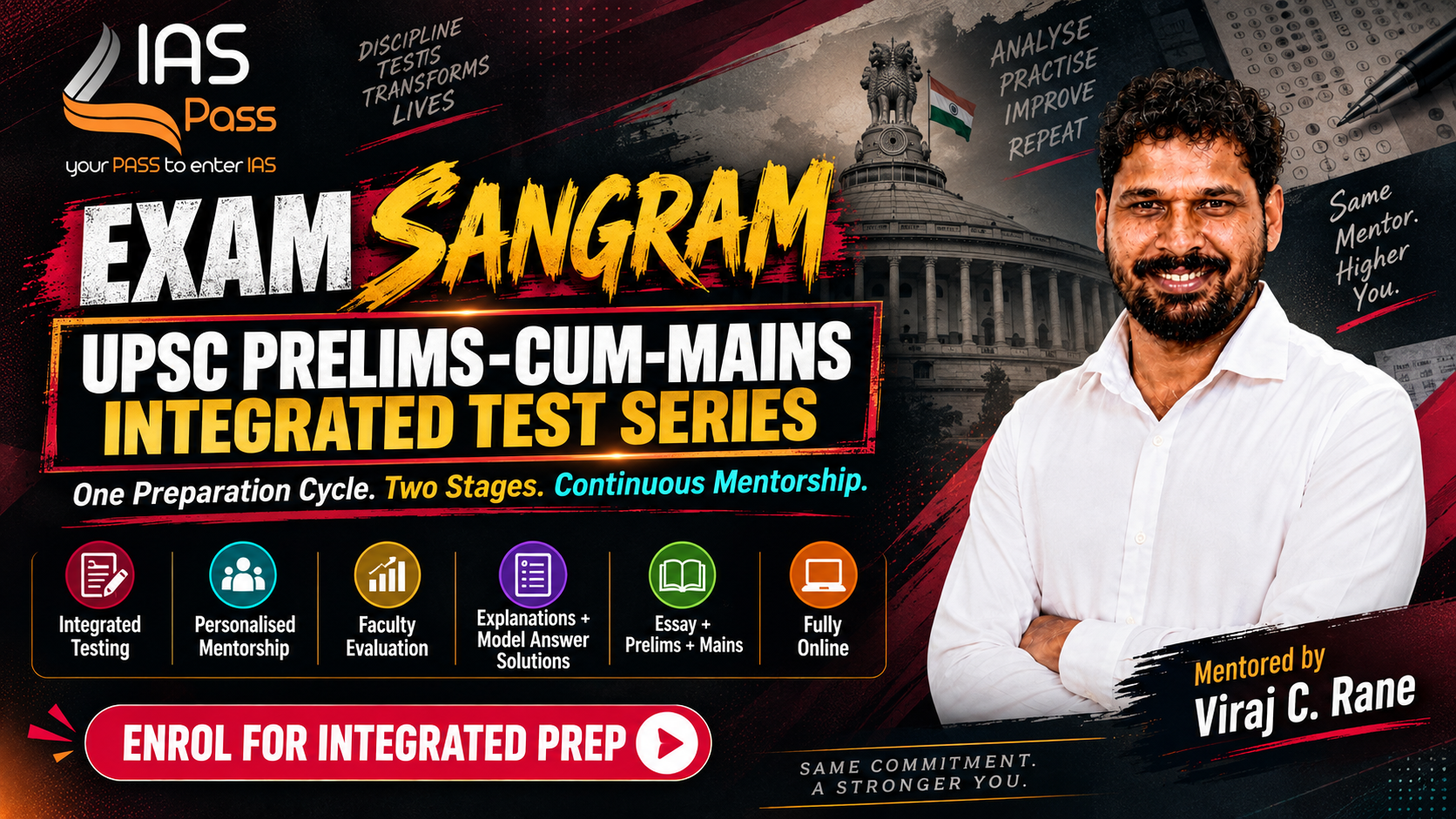
Exam Sangram 2027 – UPSC Prelims-cum-Mains Integrated Test Series
Exam Sangram 2027 is a UPSC Prelims-cum-Mains Integrated Test Series designed to...
View Details →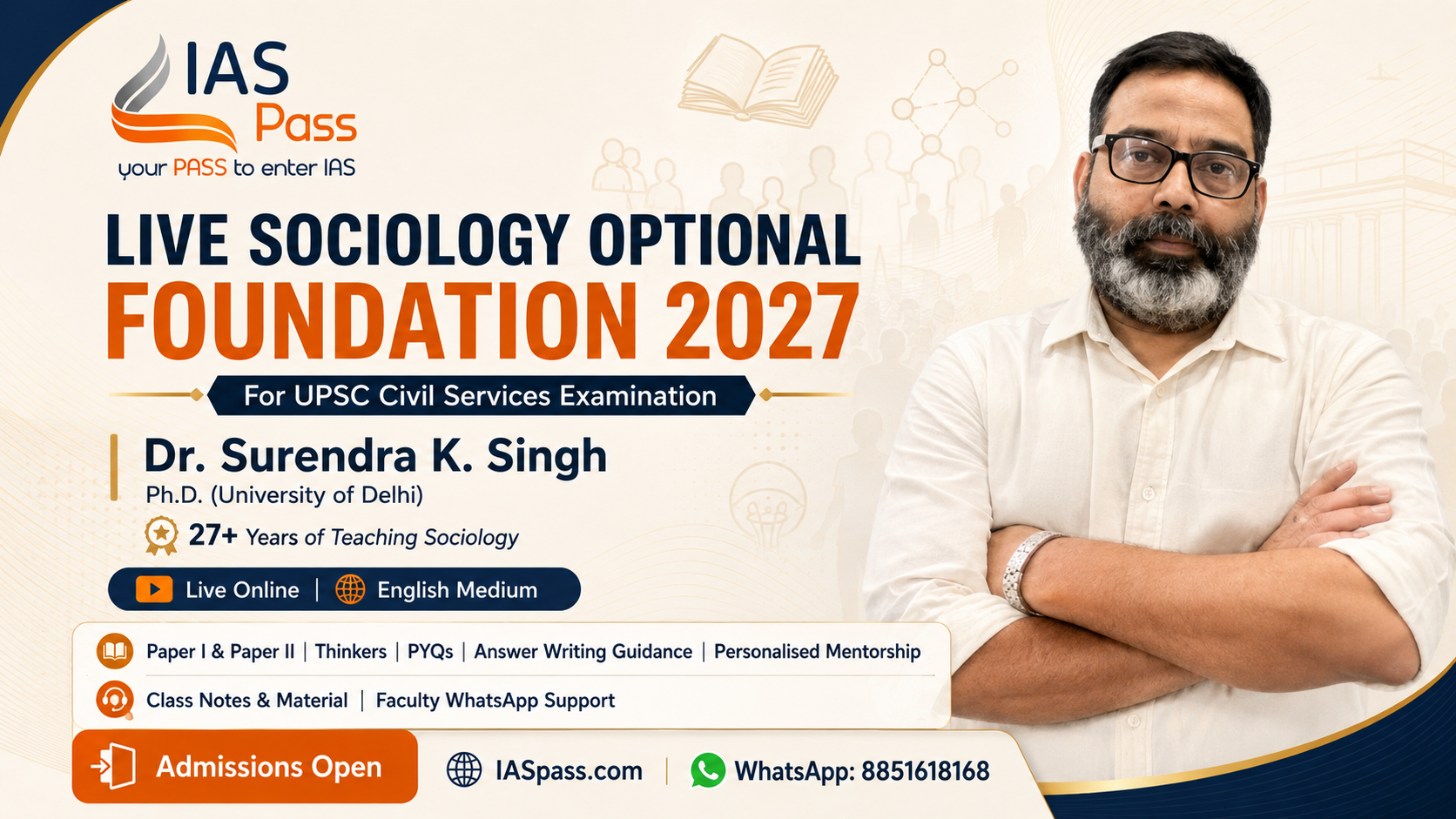
Sociology Optional Foundation 2027 | UPSC CSE | Dr. Surendra K. Singh
Sociology Optional Foundation Course for UPSC CSE 2027 with Dr. Surendra K. Sing...
View Details →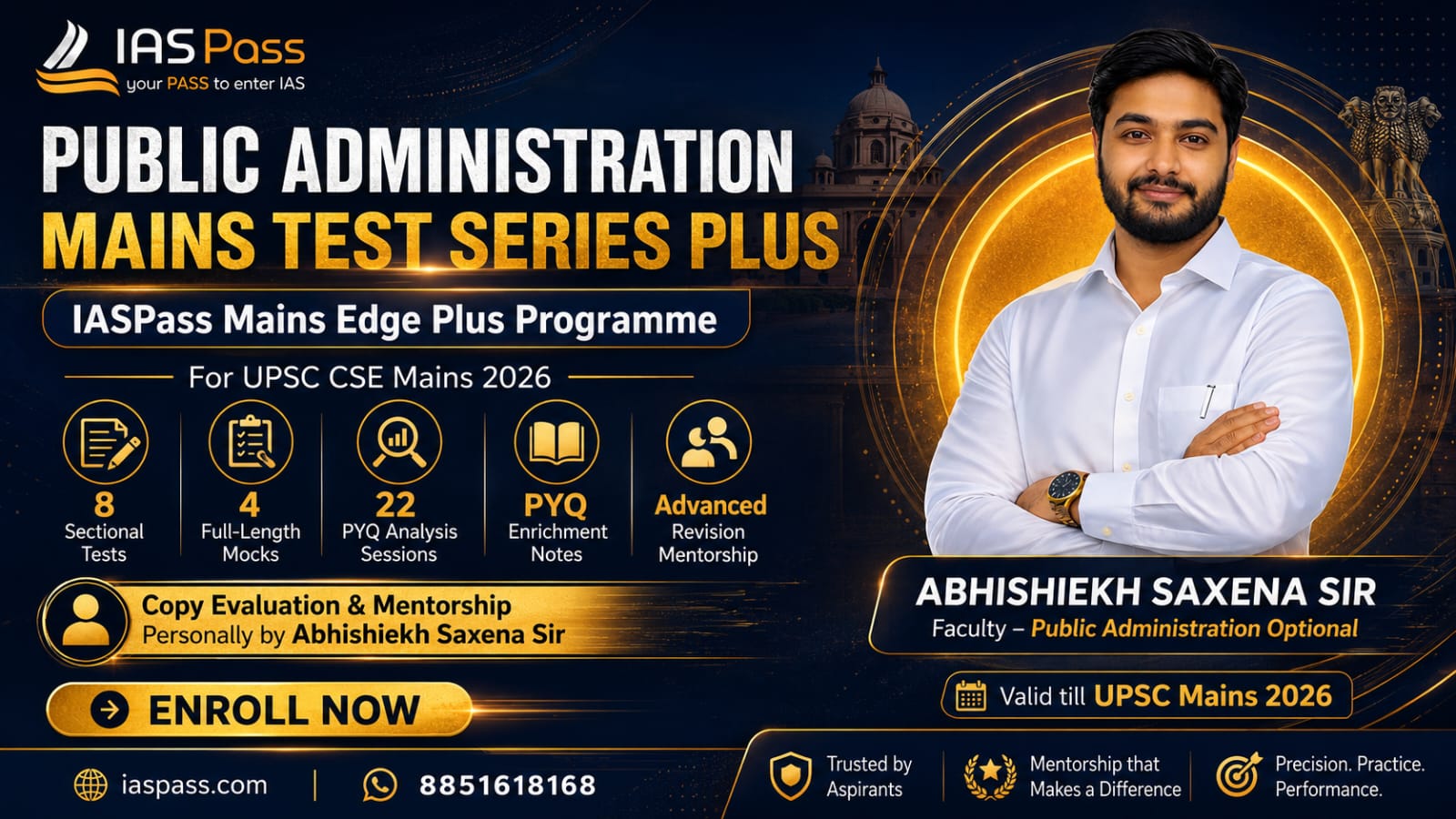
Public Administration Mains Test Series Plus
A complete Public Administration Optional Mains 2026 programme with 8 sectional...
View Details →